

Daily Practice
The Unhurried Minute: Small Experiments in Sustained Attention
Tobias Linwood··11 min read

There is a period in most days that passes without record. The first thirty to forty minutes after waking — before a working rhythm takes hold, before the inbox opens, before any of the catalogued demands of the day begin pressing forward. Three months ago this correspondent began keeping a methodical notebook of those hours. What the notebook reveals is not dramatic. But it recurs, which may be more useful.
Circadian researchers have documented, across a range of long-running published studies, that exposure to natural light in the first hour after waking appears to have a measurable effect on the body's energy patterns later in the day. The mechanism, broadly described, involves a cascade of hormonal signals that the presence of strong morning light either initiates or reinforces. The lay version of this finding — that getting outside early is useful — has circulated widely enough that it is now simply part of how many people describe their mornings.
What is less often discussed is the practical difficulty of arranging this in a northern-latitude city during winter. Between November and February, London mornings are blue-grey before nine o'clock, and many people begin their working days well before natural light reaches useful intensity. The notebook entries from those weeks reflect this: energy patterns recorded at 07:30 on a January Tuesday are markedly different in character from those recorded at the same hour in late March, when light begins to register with genuine intensity by half past six.
The adjustment the notebook eventually settled on was modest: a fifteen-minute walk immediately after waking, regardless of weather, prioritising outdoor time even when natural light was minimal. The recorded effect was not a surge in vitality but a steadiness — a physical wellbeing that held consistently across the morning into early afternoon, rather than following the usual pattern of a peak followed by a noticeable decline around eleven.
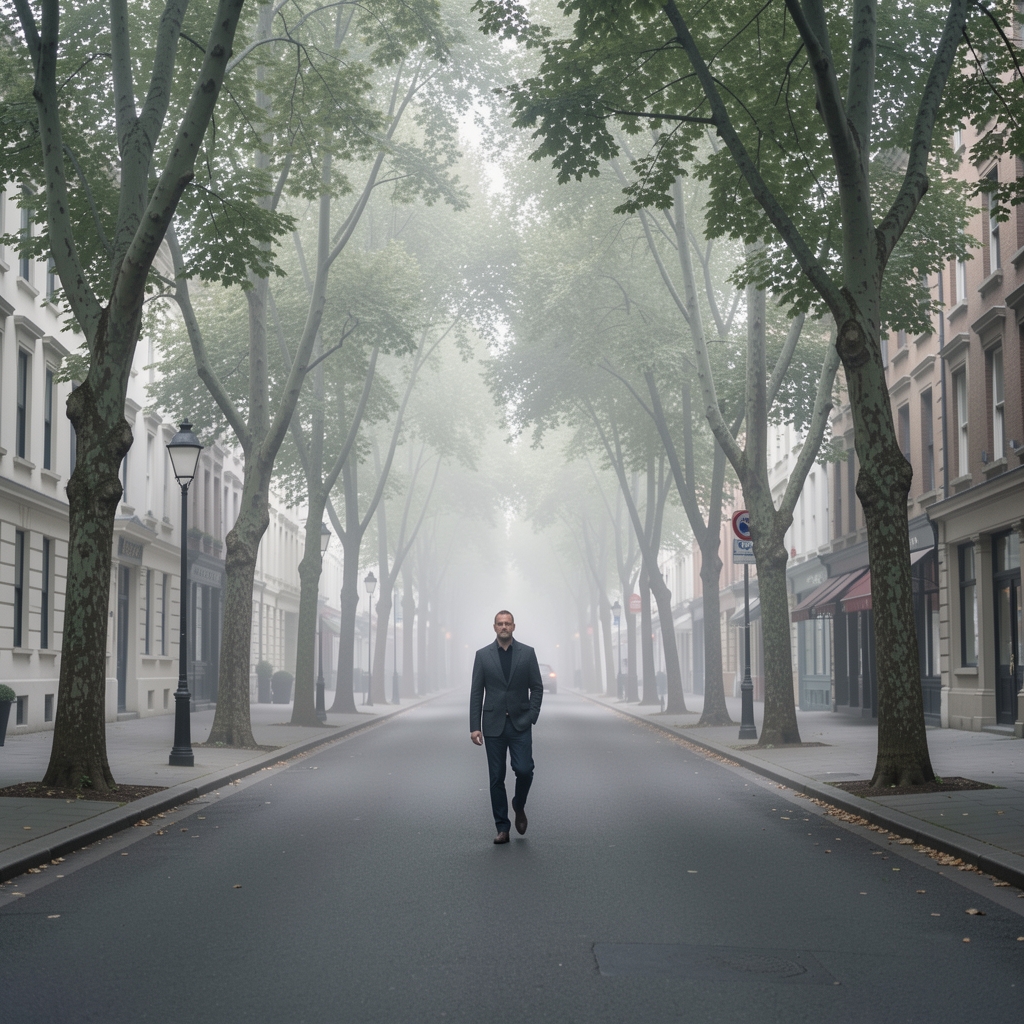
Morning walk, Soho, London — January 2026 field note
The second recurring observation concerns the placement of physical activity within the morning sequence. The notebook covers three distinct phases of experimentation: a period of desk-first mornings (email, reading, writing before any physical movement); a period of movement-first mornings (a ten-to-twenty minute physical practice before engaging with any screen); and a mixed period involving brief movement punctuating longer periods of desk work.
The difference between desk-first and movement-first mornings, as recorded across a twelve-week period, was consistent enough to note. On movement-first mornings, the capacity for sustained concentration — measured loosely as the duration of focused work before a loss of attention was noted — extended noticeably. On desk-first mornings, the same quality of concentration appeared to peak earlier and decline more steeply.
This is not a verified finding. It is an observational record from a single contributor's notebook. But it aligns with a body of published research on the relationship between physical activity and executive-function performance — research that suggests brief, moderate-intensity movement before cognitively demanding work may be associated with an improvement in working-memory capacity and sustained-attention duration. The notebook, in this case, confirms rather than discovers.
“The capacity for sustained concentration extended noticeably on movement-first mornings. On desk-first mornings, attention peaked earlier and declined more steeply.”
A third set of observations concerns the immediate physical environment of the morning workspace. These are minor in isolation but appear to interact. The notebook records experiments with room temperature (the window left open versus closed), ambient light source (natural versus artificial), and the timing and quantity of water consumed on waking.
Room temperature had a smaller measurable effect than expected. Hydration had a larger one. The entries from periods when water was consumed immediately on waking — before coffee, before any food — describe a consistent clarity in the first twenty minutes that was absent on mornings when coffee was the first liquid of the day. This observation is widely reported in wellness writing, and a degree of scepticism is appropriate: the placebo effect of any deliberate morning practice is difficult to separate from its physiological contribution. But the consistency of the record across eleven weeks of morning notes suggests at least a correlational pattern worth attending to.
Artificial light quality proved more significant than anticipated. The notebook entries from mornings where a warm-tone lamp was used as the primary light source between six and seven describe a different quality of wakefulness compared to mornings with overhead fluorescent lighting. The warm-tone lamp mornings were slower to start but sustained better across the late morning. The fluorescent mornings involved a sharper initial alertness that levelled off by ten.

Morning desk, London — notebook entry, February 2026
The notebook does not prove anything. It is a record of one person's recurring observations across a fixed period, conducted without controls and with obvious confounding variables — changes in season, workload, social schedule, and physical condition all affecting what was recorded on any given morning. These limitations are acknowledged.
What the record does offer is a set of patterns robust enough to have persisted across seasonal variation and changes in daily circumstance. The early outdoor walk, the movement-before-desk sequence, the hydration-before-coffee habit, the warm-tone lamp: these interventions are individually minor. As a combined morning sequence, they appear to produce a more durable physical wellbeing and a more stable attentional baseline across the working morning than was recorded without them.
The question of why these patterns work — the precise physiological mechanisms — is beyond the scope of a notebook. That question belongs to the researchers whose work is referenced loosely throughout this record. What a morning notebook can document is whether the patterns hold. Over three months, they did.
The notebook format used for this record was simple: a single daily entry, written before nine o'clock, covering four variables — the morning walk (yes/no, duration), the movement-before-desk sequence (yes/no, duration), hydration on waking (noted), and light quality in the workspace (noted). A brief subjective rating of physical wellbeing and attentional capacity was added at eleven o'clock each morning as a delayed self-assessment.
The value of this format is not its scientific rigour. It is its continuity. A notebook that can be completed in four minutes at the same hour every day is a notebook that actually gets completed. The data it generates is imperfect but present. Over three months, that consistency matters more than any individual entry.
Readers considering a similar exercise are encouraged to keep the format modest. The value of a morning practice notebook lies in the longitudinal pattern it reveals — not in any single entry, but in what recurs across many.