
Morning Habits
Observations on the Quiet Hours Before the Day Begins
Harriet Marsden··9 min read

The premise of this record was modest: for eight consecutive weeks, a working day would include at least one deliberate pause of no less than five minutes. The pause required no particular content — no guided audio, no prescribed posture, no equipment. Only the suspension of task-directed activity and the direction of attention toward the immediate physical environment. What the eight weeks documented was not what was expected.
The working days on record for this piece are predominantly desk-based, involving extended periods of reading, writing, and screen-facing correspondence. The physical setting is a home office in central London, north-facing, with limited direct sunlight for much of the year. Prior to the eight-week period, the working pattern involved no deliberate pauses other than those imposed by logistics — the movement between tasks, the preparation of food, the occasional departure for an errand.
The pause protocol introduced for this record specified only three parameters: it must be deliberate (not incidental), it must last at least five minutes, and it must involve a suspension of goal-directed activity. The timing within each day was left open. Some days the pause occurred mid-morning; on others, in the early afternoon or at the natural interval between two pieces of work. A brief log was kept: time of pause, approximate duration, and a one-sentence note on the quality of the following period of work.
By the third week, a secondary pause had begun to appear naturally in most days — not because it was required, but because the single pause had produced a tonal shift in the afternoon that appeared, through the log, to correlate with its presence. The secondary pause was not counted formally but was noted.

Working desk, London — field note, Week Three
The first two weeks produced no clear pattern. The log entries from these weeks describe variable results: some post-pause periods of work are noted as focused and productive; others are described as slow to restart. This was not unexpected. Any new practice requires a period of adjustment in which the body and working pattern recalibrate to its presence.
By the third week, the log entries begin to show a shift. The phrase "returned to work more readily" appears in five of seven entries in week three. In week four, similar notes appear in six of seven entries. This is a small dataset and the observation is subjective — but the consistency across the log is notable. The quality of attention following the pause appeared, over time, to stabilise into something more durable than the attention that preceded it.
The most significant observation in the first four weeks was not about the pause itself but about the transition into it. On days when the pause began with difficulty — when the pull toward task-completion made the first two minutes restless — the subsequent work session was described as more focused than on days when the pause was entered easily. The resistance, it appeared, was part of the effect.
“The resistance at the beginning of the pause appeared, across the log, to correlate with a sharper quality of attention in the work that followed.”
In the fifth week, the minimum pause duration was extended from five minutes to eight. This was not planned but emerged from the log's own evidence: entries from longer pauses consistently described better-quality subsequent work than entries from the minimum five-minute pauses. The change was tested for three weeks before it was noted as a settled adjustment.
The eight-minute pause produced a measurably different quality of stillness compared to the five-minute version. In the five-minute pause, the first two minutes were typically occupied by a kind of residual task-processing — thoughts about the work just left, anticipation of what would follow. In the eight-minute version, this residual processing appeared to clear by the third or fourth minute, leaving several minutes of what the log describes, somewhat loosely, as "settled attention" — a quality of present-moment awareness that the five-minute version rarely reached.
Published research on attentional recovery and directed attention patterns suggests that brief periods of non-directed awareness may support the restoration of voluntary attention capacity — the capacity for sustained, deliberate focus that underpins productive cognitive work. The log entries from weeks five through eight align with this body of work, though it would be an overclaim to suggest the log confirms it. What the log records is a persistent tonal pattern across eight weeks of a single contributor's working days.

Attention log, Week Six — March 2026
A secondary thread running through the log concerns physical wellbeing during desk-based working days. Prior to the eight-week period, the typical working day involved prolonged periods of sitting — three to four hours between any significant physical movement. The pause protocol introduced a point of interruption to this pattern, even when the pause was taken seated.
On days when the pause included standing — moving to a window, stepping briefly outside, or simply standing in the working space — the log entries describe a markedly different physical state by mid-afternoon. The characteristic low-level tension that accumulates across a long desk morning was, on these days, notably reduced. This observation aligns with what researchers describe as the postural and circulatory effects of brief interruptions to sustained sedentary posture, though again the log is a record of observation rather than a controlled study.
The intersection of the attentional and physical effects is the most interesting finding in the log. The days when both effects were present — a genuinely settled pause and a physical interruption to the desk posture — were described, consistently, as the most effective working days of the eight weeks. Neither effect alone produced the same result. The combination appeared to generate something greater than its parts.
The honest summary of eight weeks of deliberate pauses is that the practice proved more durable and more effective than expected. The expectation, going in, was that the pauses would be occasionally useful and frequently easy to skip. In practice, they were skipped on only four days across the eight weeks — twice because of external commitments and twice because of a working pattern that made the transition difficult. The log records those four days as notably flatter in tone than the surrounding days.
The practice that emerged from this record is now a settled feature of the working week. The pause has become, in the language of this publication, a considered routine rather than an experiment — a recurring gesture that earns its place not through dramatic effect but through consistent, quiet contribution to the quality of the day.
Readers considering a similar record are encouraged to begin with the minimum viable version: one pause, five minutes, any point in the working day, no prescribed content. Keep a one-sentence log. The pattern, if it is present, will appear in the log before it appears in memory. The log is the method.
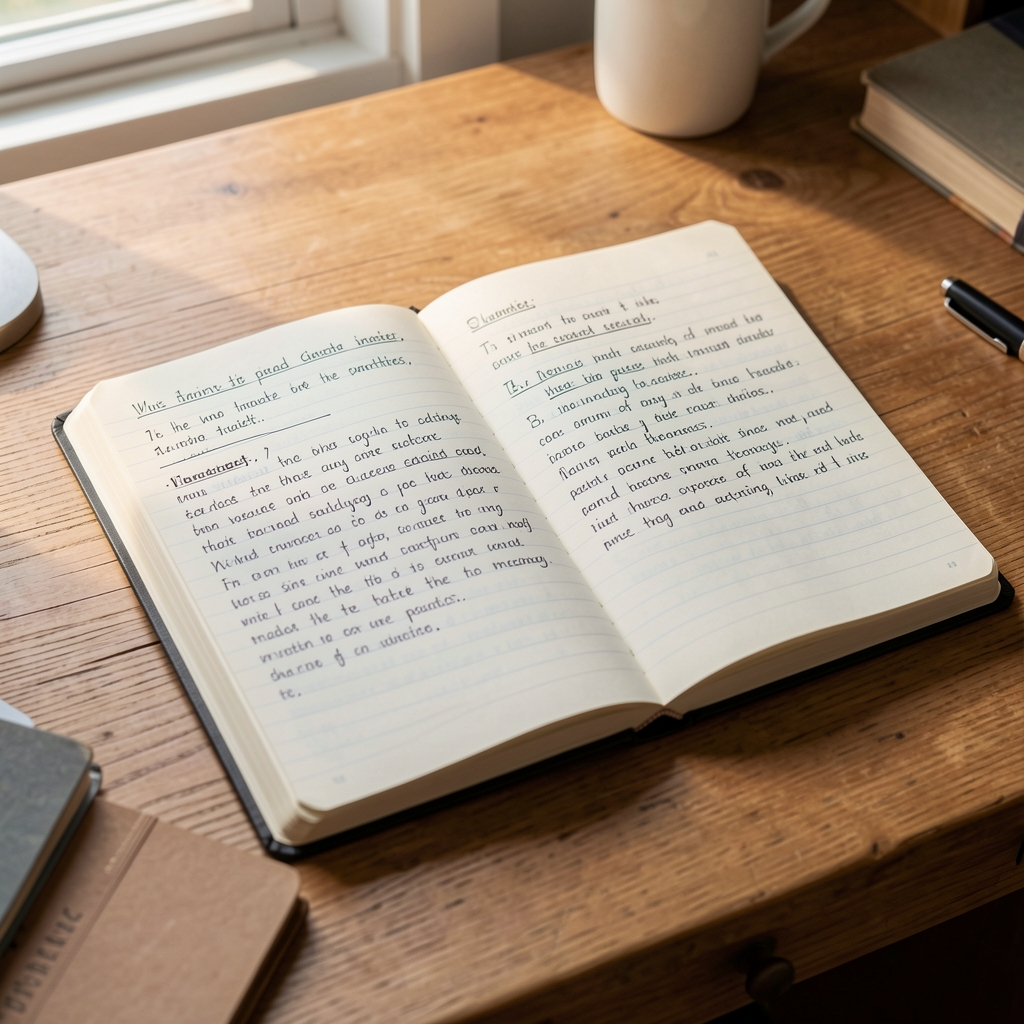
The log used for this record was a single column in a small notebook, with dated entries written at the end of each working day. Each entry contained three lines: the time of the pause, its approximate duration, and one sentence describing the quality of the subsequent work period. No rating scales were used; no numerical scores were assigned. The goal was a qualitative record, not a quantitative one.
The advantage of this format is its speed. A three-line entry takes under two minutes to write. The disadvantage is its subjectivity — the same quality of work might be described differently on a Monday and a Friday, under different levels of fatigue and different pressures. This limitation is acknowledged. The log's value lies not in any individual entry but in the longitudinal pattern, which becomes visible only after several weeks of consistent keeping.